When people ask for a tree to be "cut back", they usually mean one of three different jobs: a crown reduction, a crown thin or a crown lift. Each does something different, and choosing the wrong one can leave you with a tree that looks worse, grows back faster, or does not solve the problem you had in the first place.
The crown is everything above the trunk: the branches, twigs and leaves. All three jobs should be carried out to BS 3998, the British Standard for tree work, which sets out where cuts should be made so the tree can seal over and stay healthy.
Crown reduction
A crown reduction makes the whole tree smaller, reducing its height and spread. The ends of the branches are cut back to suitable side branches growing in the same direction, so the tree keeps a natural outline, just smaller.
Good for:
- Trees that have outgrown a garden or crowd the house.
- Reducing wind loading on a tall tree in an exposed spot.
- Bringing a tree back from a neighbour's boundary.
- Reducing weight on a tree with a known weakness.
The amount taken off should be stated in the quote, usually as metres off the height and spread. "Reduce by a third" is vague. A good quote is specific.
Crown thinning
A crown thin removes a proportion of the smaller, inner branches evenly through the crown, without changing the tree's overall height or spread. It lets more light and air through the canopy.
Good for:
- Dense trees that make a garden dark.
- Reducing wind resistance without changing the shape.
- Removing crossing and rubbing branches.
Thinning is usually limited to a modest proportion of the crown at any one time. Over-thinning strips out the inside of the tree and can trigger a burst of weak new shoots.
Crown lifting
A crown lift removes the lowest branches to raise the base of the canopy. It is the go-to job for clearance over lawns, drives, paths and roads, and for letting light in under a tree without touching the top.
Lifting is best done on smaller branches. Removing large lower limbs from a mature tree leaves big wounds close to the trunk.
Why not just top the tree?
Topping, or cutting the top off a tree at an arbitrary height, is not the same as a reduction. It leaves large stubs that tend to decay, and the tree responds with a mass of fast, weakly attached shoots. Within a few years it can be taller, denser and more dangerous than before, and putting it right costs more than doing it properly the first time.
How to choose
Start with the problem, not the job name:
- "It is too big for the space." Crown reduction.
- "It blocks the light." Crown thin, sometimes with a light lift.
- "I can't walk or park under it." Crown lift.
- "There are dead branches in it." Deadwooding, often combined with one of the above.
- "It is too close to the house whatever we do." Removal may be the honest answer. See tree felling and removal.
Some trees cope with pruning better than others. Willows and limes respond well to reduction. Birch and beech dislike heavy cutting. Conifers such as Leyland cypress do not regrow from bare brown wood, which matters a lot for hedges. See our post on overgrown leylandii hedges.
Timing and permission
The dormant season suits most reductions on deciduous trees. Our guide to the best time of year for tree work covers the exceptions. If the tree has a Tree Preservation Order or is in a conservation area, such as parts of Woodhall Spa or Horncastle, consent or notice is needed for reductions too.
Getting it done
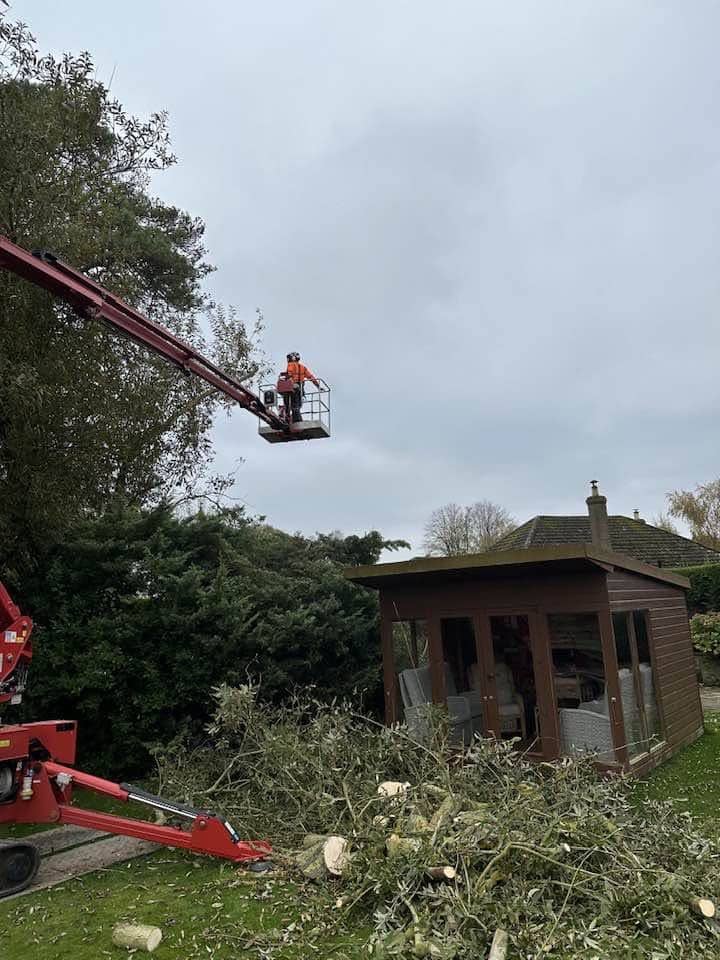
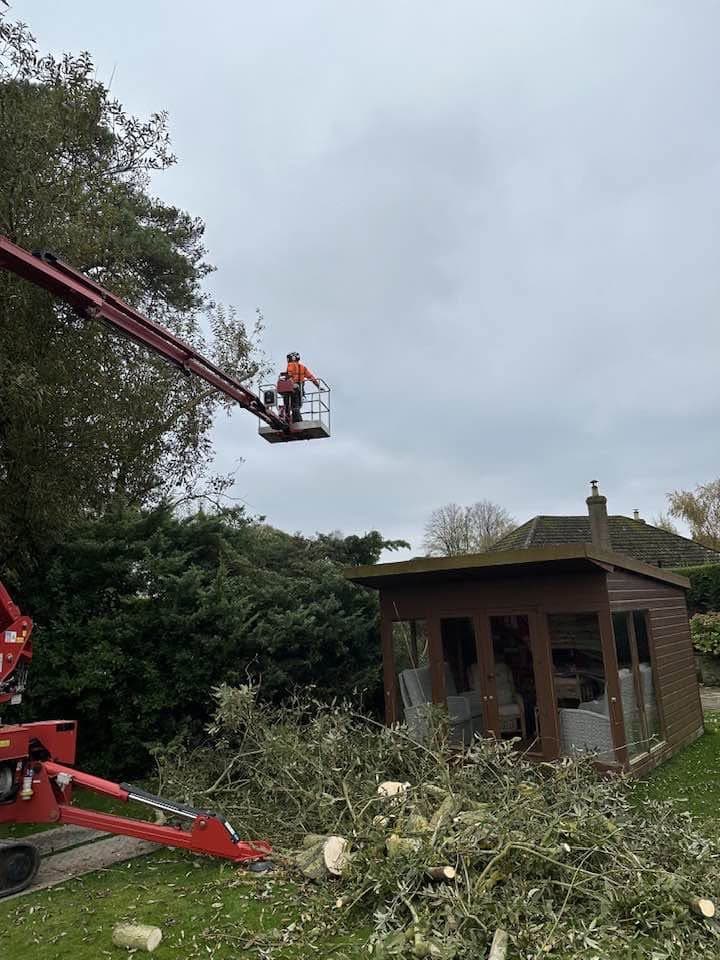
New Leaf Arb carries out reductions, thinning and lifting as part of domestic tree surgery. Taller trees can be worked from the platform with our MEWP access, and arisings are chipped on site and taken away. Ring Will on 07506 185049 or John on 07538 128890, or send the details through the contact page. Site visits are free and quotes are no obligation.
Published 25 October 2026 by Will, New Leaf Arb Tree Surgeons, Horncastle.