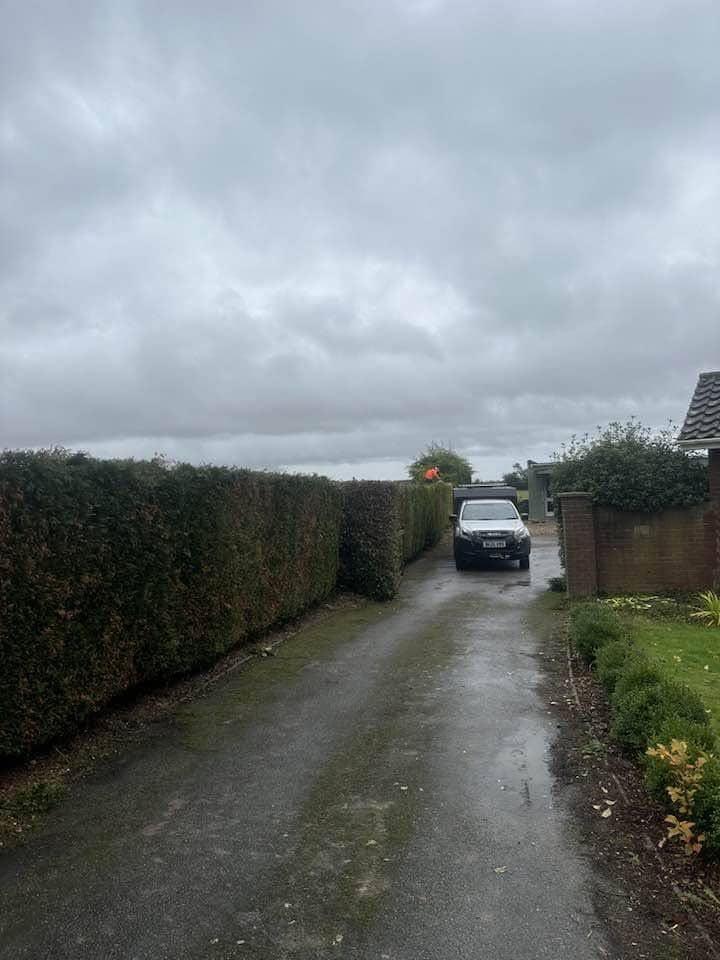
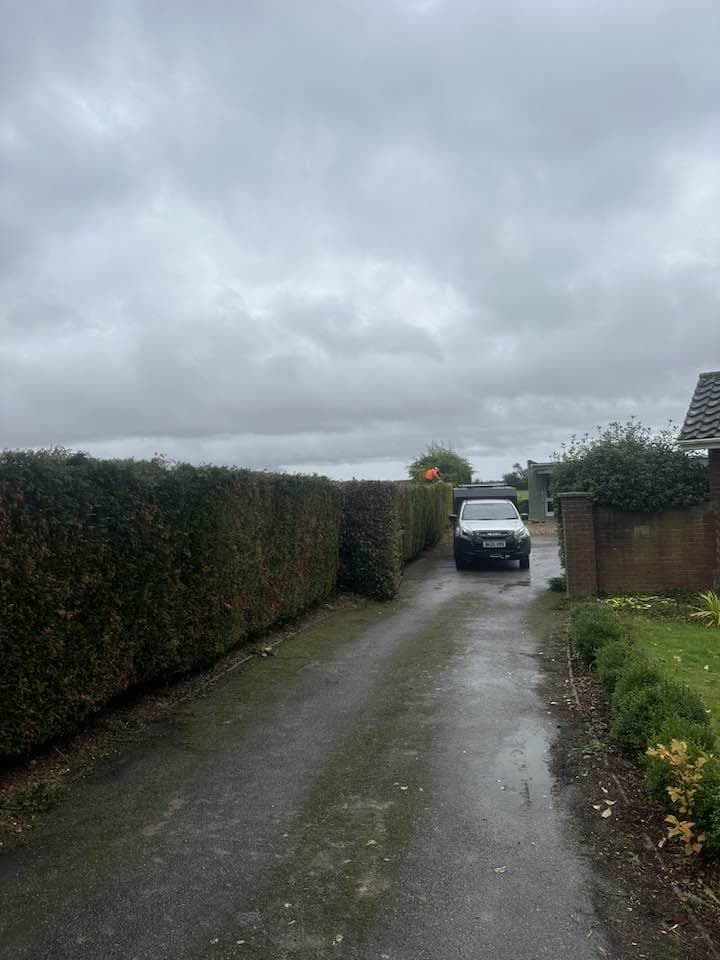
Leyland cypress, usually just called leylandii, was planted everywhere because it grows quickly into a screen. The trouble is that it does not stop. Left alone for a few years, a neat two metre hedge can become a wall of trees many metres high, shading gardens, blocking lanes and upsetting neighbours. Around Horncastle we see them along lanes, on boundaries and at the front of older properties. Here is how to deal with one.
The key fact: conifers do not regrow from bare wood
Most deciduous hedges, such as hawthorn, beech and privet, can be cut back hard and will sprout again from old wood. Leylandii will not. If you cut back past the green foliage into the brown, bare inside of the hedge, that section will usually stay bare. The RHS notes that most conifers, apart from yew, do not respond well to renovation, and Leyland cypress is one that will not tolerate hard pruning.
That shapes everything about how an overgrown conifer hedge is handled.
Reducing the height
Height is usually the main problem, and the good news is that height can be taken off. The RHS suggests reducing height by up to a third, ideally in April. A hedge cut down by more than that may stay flat and bare on top, but new shoots from the sides often fill in over time and are trained in as the new top.
For a really tall hedge, the height is often taken off from a platform rather than ladders, which is safer and gives a straighter line. New Leaf Arb's tracked spider lift is used for exactly this kind of job. See MEWP access work.
Reducing the width
Width is harder. Cutting the sides back into bare wood leaves brown patches that rarely green up. The practical options are:
- Trim the sides back only as far as there is still green growth.
- Thin selected side branches back to the trunk to let light and air into the hedge.
- Accept a wider hedge, or decide it has to go.
Where a hedge needs a big reduction, the RHS describes doing it in stages over three years: one side the first year, the other side the second, and the height in the third, with an extra year's rest if recovery is poor. Mulching and leaving a full growing season between stages helps.
When removal is the better choice
Sometimes the honest advice is to take the hedge out and replant. That is usually the case when:
- The hedge is already bare and brown on one or both sides.
- It has grown too wide for the space and cannot be narrowed without going into bare wood.
- It is causing ongoing problems with light, drains or a neighbour.
- It is close to an overhead line. See trees near power lines.
Removal involves felling or dismantling each tree, chipping the brash and dealing with the stumps. See tree felling and removal. Replanting with a slower hedge such as yew, beech or hornbeam gives a screen that is far easier to keep in check.
High hedges and neighbours
Under Part 8 of the Anti-social Behaviour Act 2003, a high hedge is one made up mainly of two or more evergreen or semi-evergreen trees or shrubs, more than 2 metres tall, acting as a barrier to light or access. If a neighbour's hedge affects your home and talking has failed, you can complain to the council. In Horncastle and the surrounding towns, that is East Lindsey District Council.
You must have tried to sort it out with your neighbour first, and councils charge a fee for a complaint. If the council agrees there is a problem, it can issue a notice requiring the hedge to be reduced and kept to a set height. It cannot order the hedge to be removed, and it does not have to make it 2 metres. Single trees and deciduous hedges are not covered.
Watch for nesting birds
Dense conifer hedges are prime nesting sites. Under the Wildlife and Countryside Act 1981, damaging or destroying an active nest is an offence. Any hedge work between late winter and late summer starts with a careful check, and large reductions are best planned for autumn or winter. Our guide to the best time of year for tree work has more.
Keeping it under control
Once a hedge is back to a sensible size, trimming once or twice a year keeps it there. Trim before it gets away from you, stay in the green, and keep the top slightly narrower than the base so light reaches the bottom.
Getting a hedge looked at
New Leaf Arb has reduced conifer hedges along a private lane near Horncastle and at the Ebrington Arms in Kirkby on Bain. You can see both on our work page. Hedge reductions are part of our domestic tree surgery and commercial tree work across Horncastle, Woodhall Spa and nearby villages. Ring Will on 07506 185049 or John on 07538 128890, or send the details through the contact page. Site visits are free and quotes are no obligation.
Published 5 November 2026 by Will, New Leaf Arb Tree Surgeons, Horncastle.