Autumn and winter gales hit open Lincolnshire hard. Around Horncastle and across the flat land towards Coningsby and the fens, there is little to break the wind, and a tree that has stood for decades can split, lean or come down overnight. If it happens to you, this is what to do.
1. Keep people away
A tree that has partly failed is at its most dangerous. Split limbs can be hanging under tension, and a leaning tree may still be moving as the root plate lifts. Keep everyone, including children and pets, well clear of anything underneath or within reach if it falls further. Do not try to pull, prop or cut it yourself. Storm-damaged timber is loaded in unpredictable ways, and even experienced chainsaw users get caught out by it.
2. Check for power lines
If a tree or branch is touching, or close to, an overhead wire, assume the line is live. Stay well away and ring 105, the free national number for power cuts and damaged lines. Around Horncastle the network operator is National Grid Electricity Distribution. Health and Safety Executive guidance treats 10 metres from an overhead line as the zone where work should not happen without the network operator's advice. If the tree is across a road, ring the police on 999 if there is danger to traffic.
3. Photograph everything
Before anything is moved, take photos of the tree, the damage and anything it hit. If you need to claim on home insurance, or if the tree turns out to be protected, photographs taken at the time make life much easier. Note the date and time.
4. Protected trees in an emergency
Normally, work on a tree with a Tree Preservation Order needs the council's consent, and trees in conservation areas need six weeks' notice. Government guidance makes an exception where a tree poses an immediate risk of serious harm: the urgent work needed to make it safe can be done straight away, with written notice given to the council as soon as practicable afterwards. That covers only the work needed to remove the danger, not a general tidy-up. For dead protected trees that are not an immediate risk, 5 working days' notice is required. Our guide to tree preservation orders explains the rest.
5. Call a qualified tree surgeon
When you ring, it helps to say:
- What kind of tree it is, if you know, and roughly how big.
- Whether it is down, split or leaning, and what is underneath.
- Whether there are any wires nearby.
- How easy it is to get to, such as a side gate or field access.
The first job is making the tree safe. That might mean removing a hanging limb, taking weight out of a split tree, or dismantling it in sections. Where a tree has fallen across a building, it is usually taken apart piece by piece and lowered off rather than pulled. See tree climbing and dismantling.
Why platforms help after storms
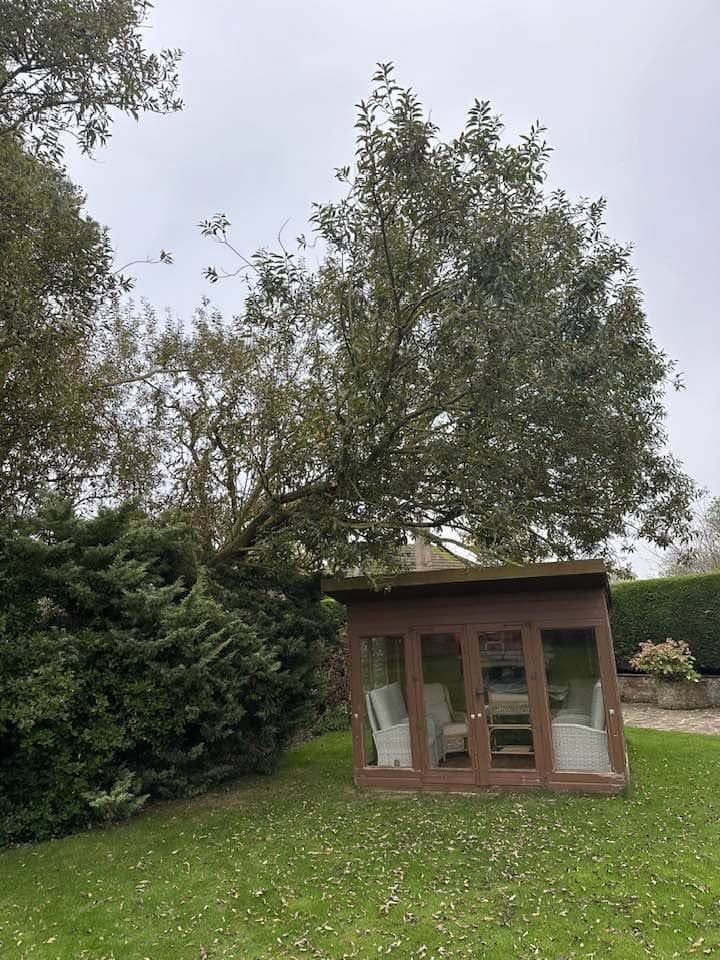
A damaged tree is not always safe to climb. Anchor points may be cracked, and the tree may shift as weight is removed. Working from a platform keeps the arborist off the tree altogether. New Leaf Arb's 23m tracked spider lift fits through a standard gateway and works on soft ground, and the 13m 4x4 MEWP handles fields and rough access. Read more about MEWP access work. One of the jobs on our work page is a split willow taken down in sections from directly above a summer house.
Whose tree is it?
As a rule, the owner of the land the tree grows on is responsible for it. If a neighbour's tree has come down on your property, talk to them, and both of you should speak to your insurers. If a tree from your land has fallen onto a road or footpath, contact Lincolnshire County Council's highways team as well as getting the tree dealt with.
After the clear-up
Once the danger is dealt with, look at what is left. A tree that has lost a major limb may be unbalanced or open to decay, and the remaining trees nearby will now be more exposed to wind. It is worth having them looked at. Our guide to the signs a tree may be unsafe covers what to look for.
Prevention
Many storm failures give warning signs: deadwood, cracks, fungal growth or a lean that has changed. A crown reduction or thin can reduce wind loading on a tall tree in an exposed spot. See crown reduction vs crown thinning.
New Leaf Arb covers Horncastle, Coningsby and the surrounding villages for tree felling and removal after storm damage. Ring Will on 07506 185049 or John on 07538 128890, or send the details through the contact page. Site visits are free and quotes are no obligation.
Published 29 October 2026 by Will, New Leaf Arb Tree Surgeons, Horncastle.