
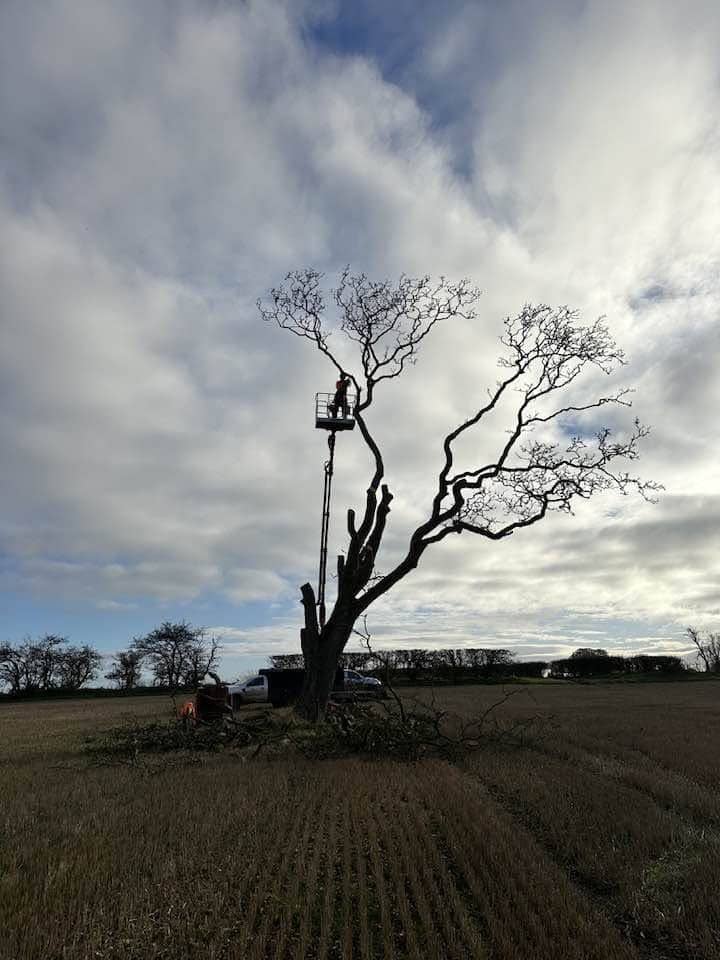
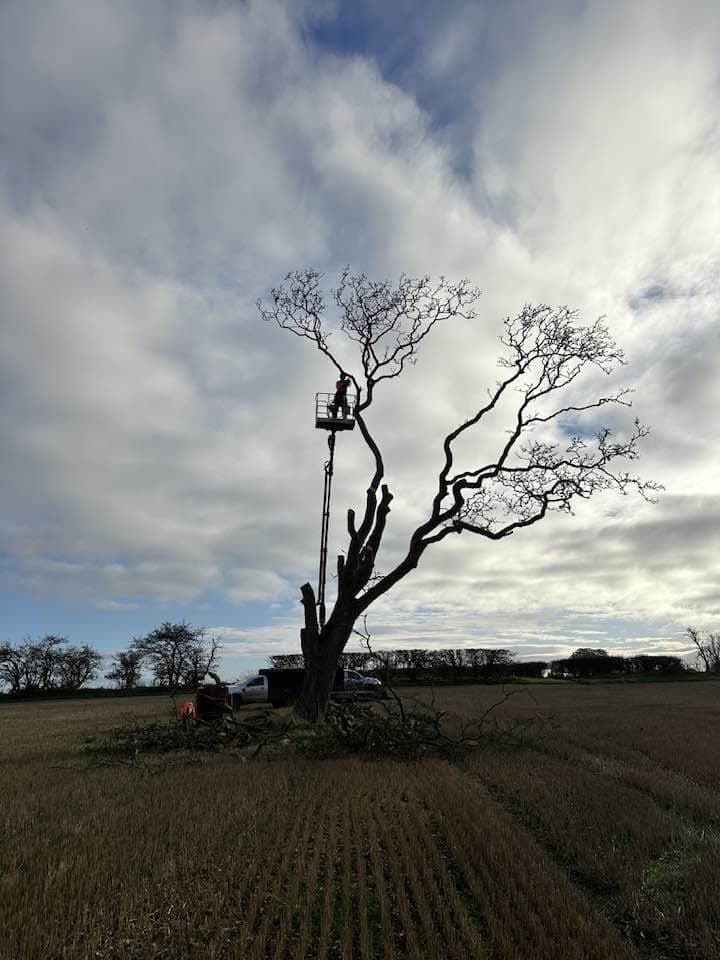
Most trees are perfectly safe, and most of the time a tree that fails gave some warning beforehand. You do not need to be an expert to spot many of those signs from the ground. A walk round your trees once a year, and again after a big storm, is a sensible habit, especially for trees near houses, roads, footpaths and play areas.
This checklist covers what to look for. If you see any of it, get the tree looked at by a qualified arborist rather than guessing.
In the crown
- Dead branches. Bare, brittle branches in an otherwise leafy tree, or branches that have lost their bark. Dead wood falls, and large deadwood over a path or roof is a priority.
- Hanging or broken limbs. Branches snapped but still caught in the crown, sometimes called hangers. These can drop without warning.
- Thinning or early leaf loss. A crown that is noticeably sparser than it was, or leaves browning early. This can point to root problems or disease such as ash dieback.
- Dieback from the top. Dead tips at the top of the crown often mean the tree is struggling.
On the trunk and main branches
- Cracks and splits. Vertical cracks in the trunk, or splits where large branches join.
- Weak forks. Two stems of similar size growing tightly together with bark squeezed between them. These unions can split apart, especially in wind.
- Cavities. Holes and hollows. Some hollow trees are sound, but a cavity needs assessing for how much solid wood is left.
- Loose or missing bark over large areas.
- Oozing or dark weeping patches.
Fungi
Mushrooms or brackets growing on the trunk, on the roots or in the ground around the base can be a sign of decay inside the tree. Some fungi are harmless, while others, such as honey fungus, can cause serious decay and root failure. Fungal fruiting bodies are often seasonal and short-lived, so take a photo when you see them. That photo is very useful to an arborist later.
At the base and roots
- Lifting soil or cracks in the ground on one side of the tree, especially after wind. This can mean the root plate is moving.
- Root damage. Trenches for drains, cables or driveways cut close to a tree can sever major roots. Problems can show up years later.
- Changed ground levels. Soil piled up against a trunk, or ground scraped away from the roots.
- Waterlogging. On heavy soils and low-lying land, roots in waterlogged ground can struggle and anchor less well.
A lean that changes
Plenty of trees lean and are perfectly stable, having grown that way for decades. What matters is a lean that is new or getting worse, particularly with soil heaving on the opposite side. Treat that as urgent.
Local conditions around Horncastle
Much of the land between Horncastle, Coningsby and the fens is flat and open, so trees take the full force of westerly gales. Trees that have suddenly been exposed, for example after a neighbouring tree or a hedge has been removed, are more vulnerable. Willows and poplars, which are common along drains and field edges, grow fast and can drop large limbs. If you have big trees in an exposed spot, a periodic check is worthwhile.
What happens next
An arborist will look at the tree from the ground and, where needed, from the crown. The outcome might be:
- No work needed, just keep an eye on it.
- Deadwood removal or a crown reduction to take weight off.
- Removing a single limb.
- Felling or dismantling the tree. See tree felling and removal and tree climbing and dismantling.
If the tree may be protected, the rules still apply, though urgent work to remove an immediate danger can go ahead with notice to the council afterwards. See our TPO guide. For trees that have already failed, read what to do after storm damage.
Book a look
Will and John cover Horncastle, Tattershall, Coningsby and nearby villages for domestic tree surgery. Ring Will on 07506 185049 or John on 07538 128890, or send the details through the contact page. Site visits are free and quotes are no obligation.
Published 9 November 2026 by Will, New Leaf Arb Tree Surgeons, Horncastle.